
Overview
Parflow Manifold Valves are engineered to simplify instrument installation while improving the safety, reliability, and efficiency of pressure measurement systems. By integrating multiple valve functions into a single compact assembly, these manifolds reduce installation complexity, minimize potential leak paths, and provide operators with complete control over instrument isolation, pressure equalization, venting, and calibration.
Modern process plants rely heavily on pressure transmitters, differential pressure transmitters, gauges, and analyzers to monitor critical process parameters. These instruments require periodic maintenance, calibration, and replacement without disrupting plant operations. Traditional installations using multiple individual valves and fittings increase the number of threaded connections, consume valuable installation space, and create additional potential leak points.
Parflow Manifold Valves address these challenges by combining multiple valve functions into one precision-engineered assembly. Available in 2-Valve, 3-Valve, and 5-Valve configurations, the Parflow Manifold Valve range enables engineers to select the most appropriate solution based on instrument type, process requirements, and maintenance philosophy. The result is a cleaner installation, improved operational safety, reduced installation time, and enhanced long-term reliability.
Working principle
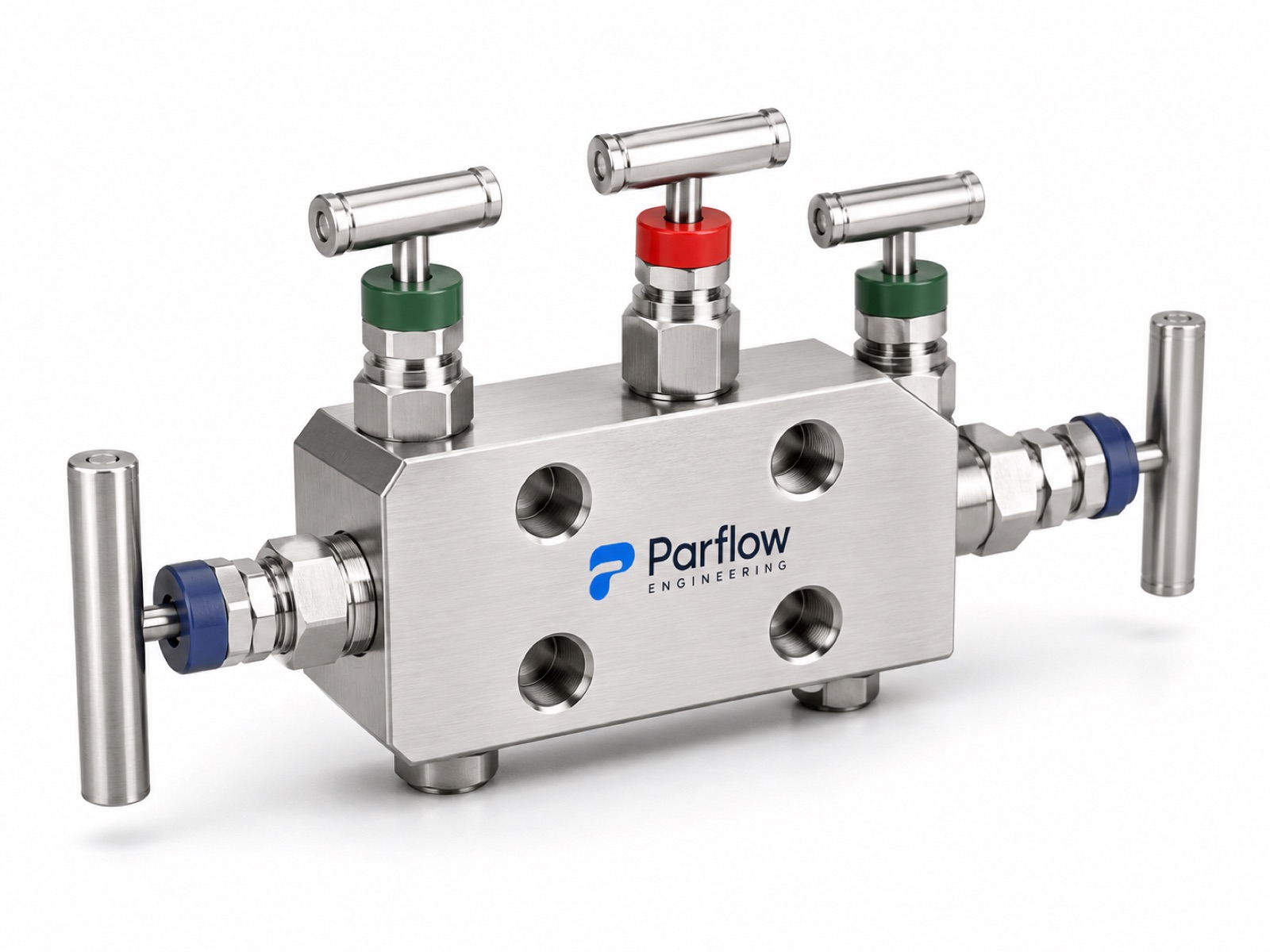
The manifold sits between process and instrument. Isolation valves disconnect the instrument from the process without shutting the line; the equalizing valve balances pressure across a DP transmitter's ports before maintenance, protecting the sensing element; vent valves safely release trapped pressure before servicing.
Internal flow passages machined into a single body replace external tubing, fittings, and individual valves: fewer threaded joints, better mechanical integrity, and a far smaller footprint.
At a glance
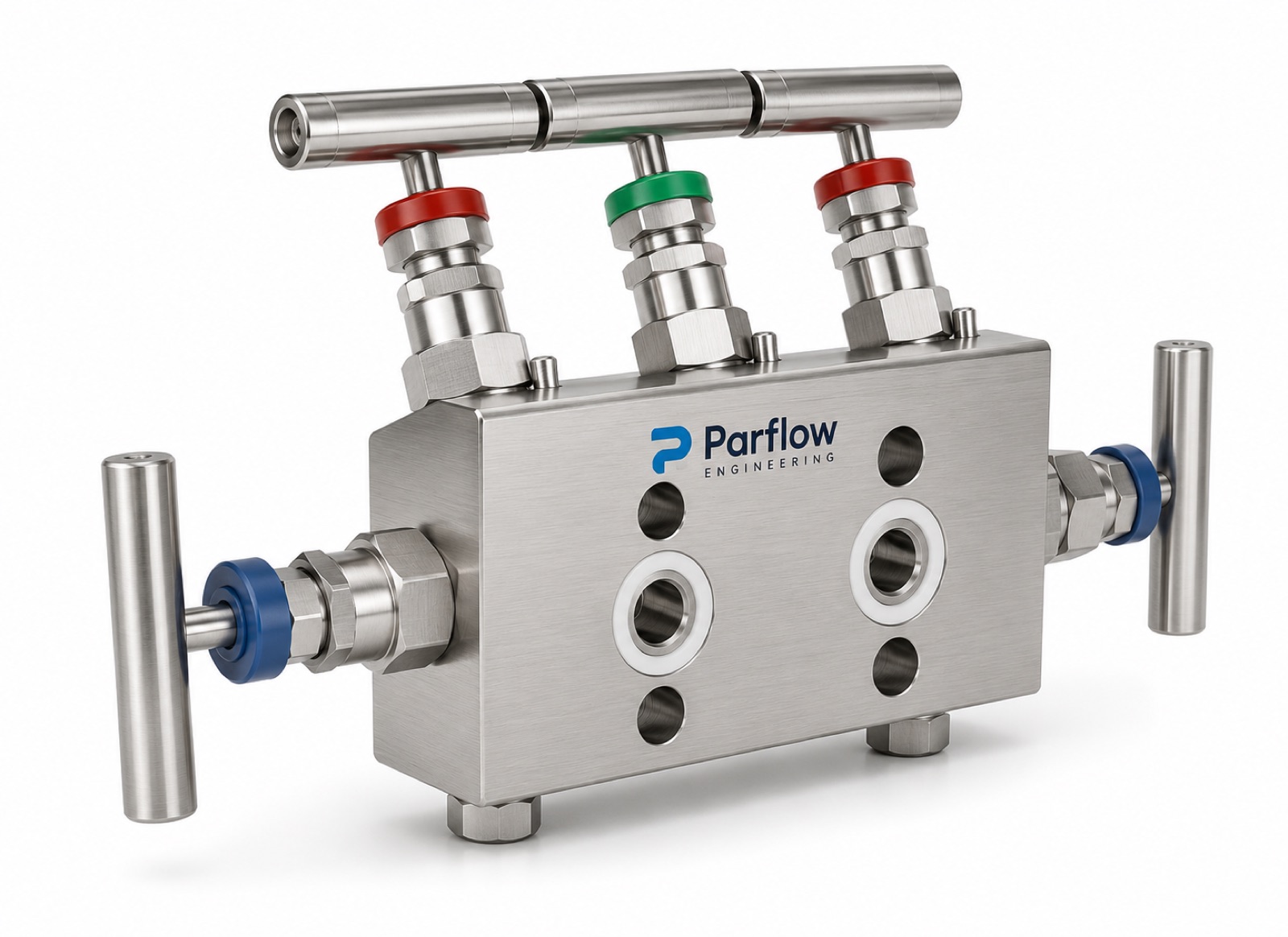
The only real decision on this page is the valve count. All three configurations share the same body materials, end connections and 6,000 psi ceiling, what changes is which functions are built in.
| Configuration | Valves in the body | What it does | Specify it for |
|---|---|---|---|
| 2-valve | 1 isolate + 1 vent | Isolate the instrument from the process, then vent trapped pressure before removal | Static / gauge pressure transmitters and pressure gauges |
| 3-valve | 2 isolate + 1 equalize | Isolates both impulse lines and equalizes across the cells so the transmitter never sees full DP during start-up or zeroing | DP transmitters, flow and level measurement |
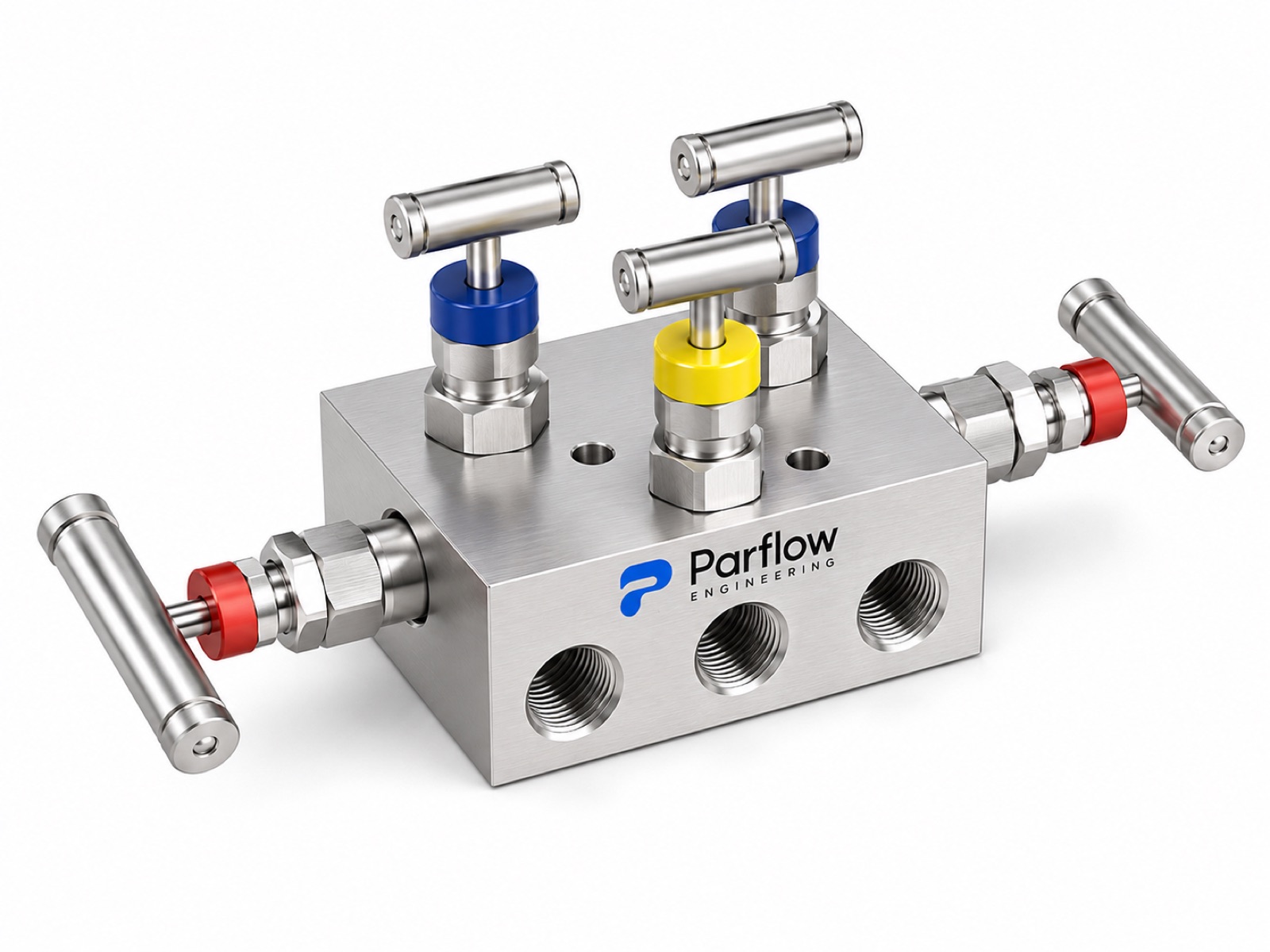
| 5-valve | 2 isolate + 1 equalize + 2 vent | Adds dedicated vent/test ports on each side, so the transmitter can be bled and calibrated in place without breaking the hook-up | Custody transfer and metering, calibration systems |
Count the impulse lines. One line into the instrument means a 2-valve is enough. Two lines (differential) require an equalize valve, that is the 3-valve. Choose the 5-valve only when the instrument must be vented, zeroed or proved in place; the two extra vent ports exist for calibration access, not for higher pressure. Rating is 6,000 psi and sizes are 1/4" to 1/2" across all three, so the configuration choice does not constrain the rest of the specification.
Key features
- Isolate / equalize / vent in one integrated body
- 2-, 3-, and 5-valve configurations
- Fewer threaded connections: fewer potential leak paths
- Compact: less installation space and weight
- Safe pressure equalization for DP transmitters
- Simplifies calibration, commissioning, and maintenance
Technical advantages
The greatest advantage of a manifold valve lies in system simplification. Replacing multiple individual valves, fittings, and tubing connections with a single integrated assembly reduces installation time, lowers inventory requirements, and minimizes potential leakage points throughout the instrumentation system. The compact construction improves accessibility for maintenance personnel while reducing the overall footprint of the installation.
Fewer mechanical joints also improve long-term reliability by reducing opportunities for vibration-related loosening or external leakage. For differential pressure instrumentation, integrated equalization significantly reduces the risk of transmitter damage during maintenance by allowing pressure to be balanced safely before removal or calibration. By simplifying installation and maintenance procedures, Parflow Manifold Valves help reduce plant downtime while improving operator safety and measurement reliability.
Applications
- Pressure & DP transmitter installations
- Flow measurement systems
- Level measurement systems
- Filter monitoring
- Process analyzers
- Calibration systems
- Instrument impulse lines
- Custody transfer & metering
Configurations
- 2-valve (isolate + vent) for static pressure; 3-valve (2× isolate + equalize): the DP transmitter standard; 5-valve (2× isolate + equalize + 2× vent) for custody transfer
- metering
critical instrumentation. Direct-mount and remote-mount patterns.
Industries served
- Oil & Gas
- Petrochemical
- Chemical Processing
- Refining
- Power Generation
- LNG & Industrial Gas
- Pharmaceutical
- Water & Wastewater
- Marine & Offshore
- Hydrogen Energy
Why choose Parflow
Instrumentation systems demand more than accurate measurement: they require safe maintenance, dependable isolation, and efficient operation throughout the life of the plant. Parflow Manifold Valves are engineered to deliver all of these functions within a single, compact assembly. By integrating multiple valve operations into one precision-manufactured unit, they simplify installation, improve maintenance efficiency, reduce potential leak paths, and enhance overall system reliability.
Whether applied to a simple pressure gauge or a critical differential pressure transmitter, Parflow Manifold Valves provide engineers and plant operators with an efficient, space-saving solution that supports safer maintenance practices and reliable process performance. Designed for modern instrumentation systems, they represent an intelligent approach to process interface management where operational integrity and long-term reliability are essential.
FAQ
2-valve vs 3-valve vs 5-valve, how do I choose?
2-valve for static pressure instruments (isolate + vent). 3-valve for DP transmitters (two isolations + equalizer). 5-valve when both instrument ports must vent independently: custody transfer, flow metering, and calibration-critical installations.
Why equalize before servicing a DP transmitter?
Opening the equalizing valve balances pressure across the transmitter's high and low ports, preventing a damaging differential across the sensing element during isolation, calibration, or removal.
What do manifolds replace?
The conventional hook-up of several individual valves, nipples, tees, and tubing runs. One machined body means fewer joints, fewer leak paths, less space, and faster installation.