
Overview
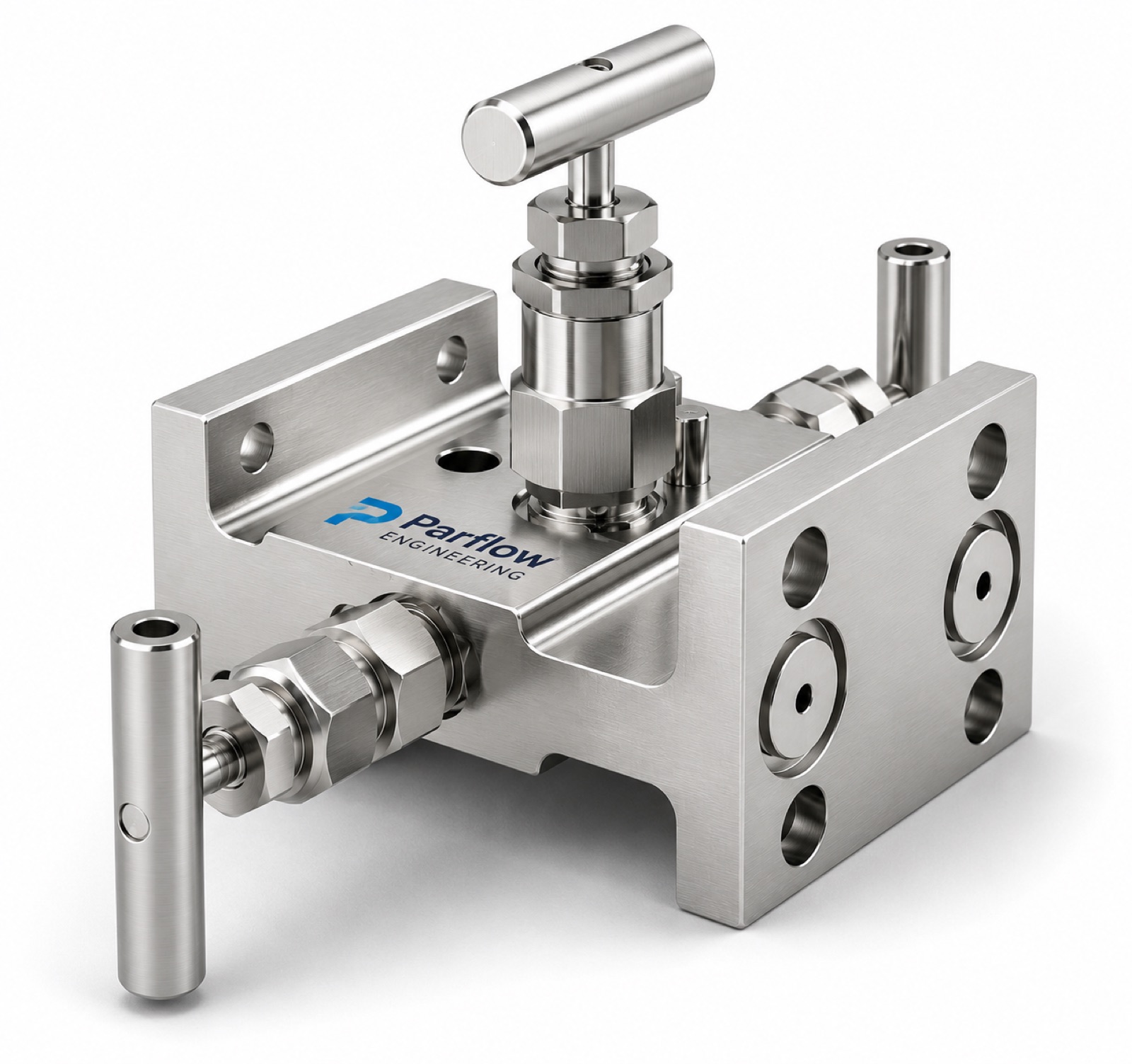
Parflow Instrument Manifolds are precision-engineered process interface solutions designed to establish a safe, reliable, and efficient connection between field instruments and process piping. By integrating multiple valve functions into a compact assembly, instrument manifolds enable isolation, pressure equalization, venting, draining, and calibration without disturbing the primary process line.
The result is improved measurement reliability, enhanced operational safety, reduced installation complexity, and significantly lower maintenance time. In every industrial process, accurate instrumentation is fundamental to efficient plant operation. Pressure transmitters, differential pressure transmitters, gauges, switches, and analyzers continuously provide the data required for process control, safety systems, and operational decision-making.
However, these instruments also require periodic calibration, inspection, replacement, and maintenance. Without an appropriate manifold, these activities often require multiple individual valves, fittings, tubing connections, and additional installation space, increasing both complexity and the potential for leakage. Parflow Instrument Manifolds provide a compact and integrated solution that simplifies these installations while maintaining the high level of process integrity expected in critical industrial applications.
Designed for demanding environments across the oil & gas, petrochemical, chemical, power generation, and process industries, they offer engineers a reliable interface between the process and the instrument. The Critical Link Between Process and Instrumentation Instrumentation systems are only as reliable as the interface connecting them to the process. Every pressure impulse line, transmitter, and gauge must be capable of being safely isolated for maintenance without interrupting plant operations or compromising personnel safety.
Instrument manifolds serve as this interface by incorporating the valve functions necessary for commissioning, normal operation, maintenance, and calibration into a single engineered assembly. Rather than assembling multiple block valves, bleed valves, equalizing valves, adapters, and fittings individually, engineers can install one compact manifold that performs all these functions while occupying significantly less space.
The integrated construction reduces the number of mechanical joints, minimizes potential leak paths, and creates a cleaner, more serviceable installation. This makes instrument manifolds an industry-standard solution for modern process instrumentation.
Working principle
Installed directly between process connection and instrument, the manifold is the control point for commissioning, operation, and maintenance. Isolation valves pass or cut process pressure; equalizing valves balance DP transmitter ports; vent valves depressurize the instrument side safely before servicing.
Precision-machined internal passages replace external tubing and individual valves, reducing joints and bending loads on transmitters while keeping every function independently operable.
At a glance
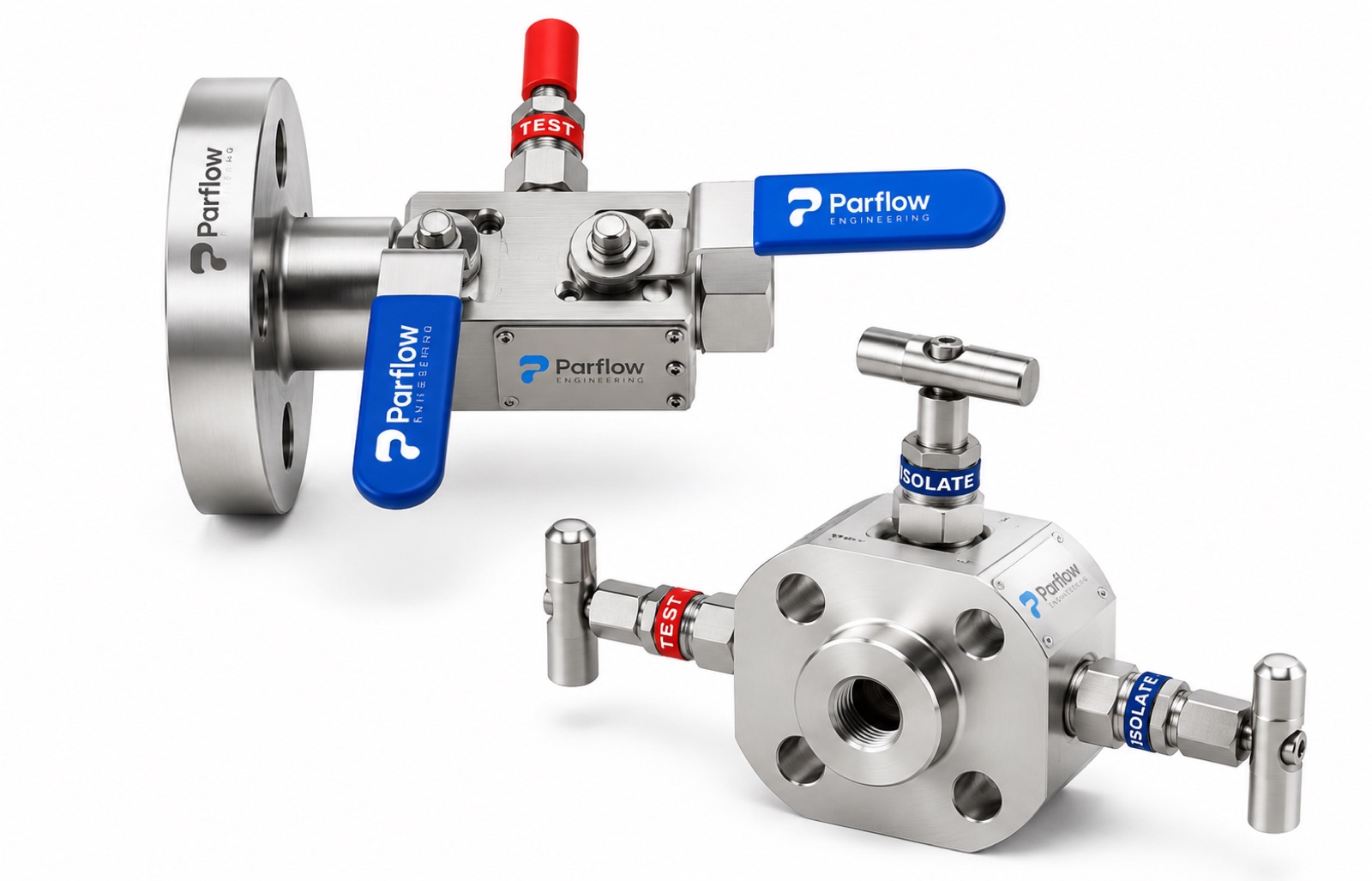
The manifold carries the widest stated temperature range of any product in the Parflow range, 306°C wider than the next-widest, and the top of that range is set by which packing you specify, not by the body.
The 538°C figure is the range across all three packing options, PTFE, Graphite and Live-Loaded PTFE, not a rating any single one holds. The table states the span only as "depending on packing", so confirm the limit for the packing you specify before quoting it on a hot service. Live-Loaded PTFE is the option to ask about where thermal cycling would otherwise loosen the gland.
Key features
- Complete process-instrument interface in one assembly
- 2-, 3-, and 5-valve configurations
- Reduced installation space and system weight
- Minimized threaded joints and leak paths
- Safe isolation, equalization, and venting
- Streamlined calibration and recommissioning
Technical advantages
Parflow Instrument Manifolds provide significant advantages over conventional valve assemblies by integrating essential valve functions into one precision-engineered product. The reduction in individual valves, fittings, adapters, and tubing not only shortens installation time but also improves long-term system reliability by reducing potential leakage points. Compact construction makes installations cleaner and easier to access, particularly in process skids, offshore facilities, analyzer shelters, and high-density instrumentation panels.
For maintenance personnel, instrument manifolds streamline routine servicing by allowing instruments to be safely isolated, depressurized, calibrated, and recommissioned without disturbing the process piping. This minimizes plant downtime while improving operator safety and preserving instrument accuracy. The integrated design also contributes to improved structural rigidity and lower mechanical loading on transmitters compared with conventional assembled installations.
Applications
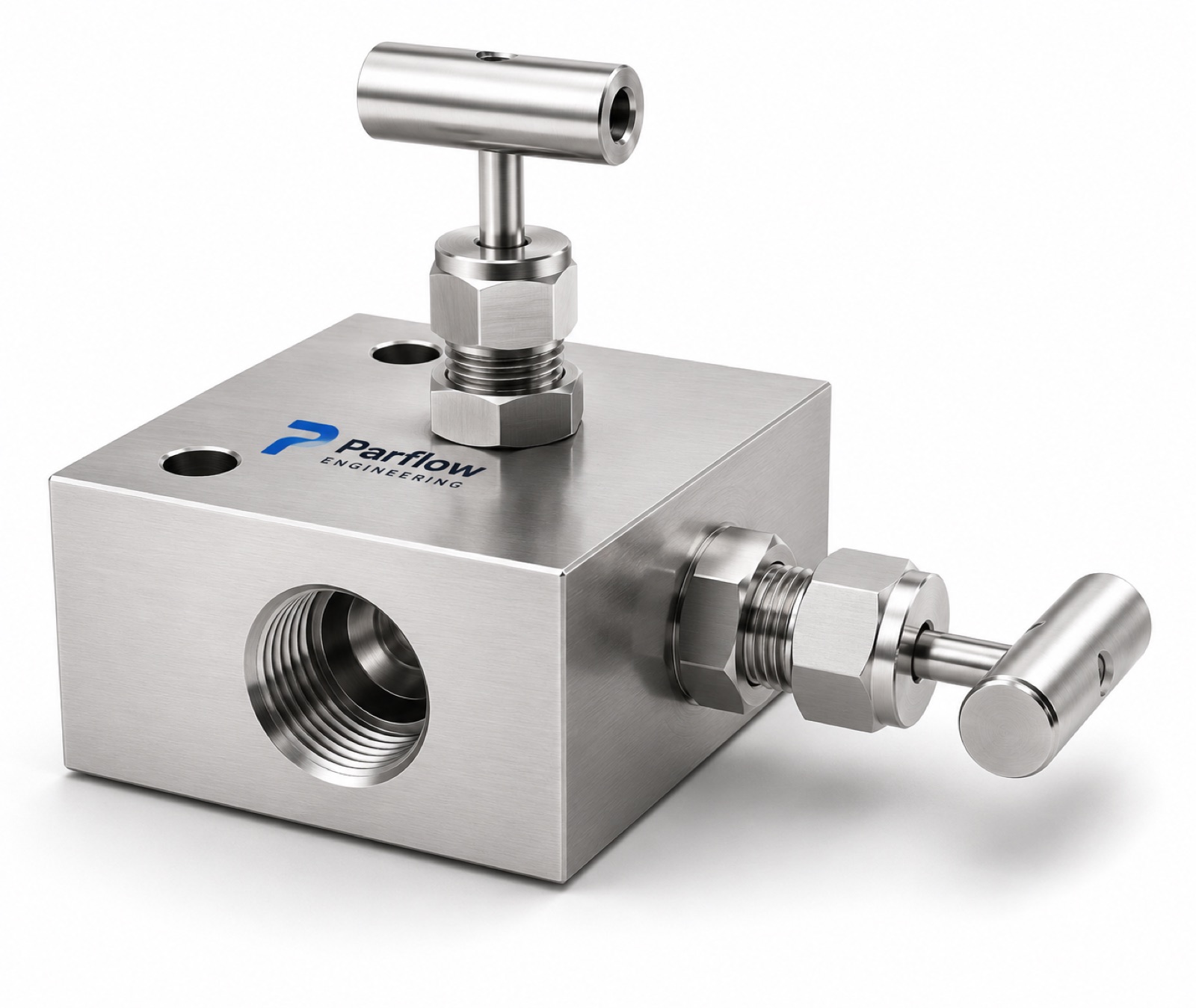
- Pressure & DP transmitter installations
- Flow & level measurement systems
- Process analyzers
- Calibration equipment
- Instrument impulse lines
- Custody transfer systems
- Process control panels
- Process automation systems
Configurations
- 2-valve (isolate + vent) for static pressure; 3-valve (2× isolate + equalize) for DP transmitters; 5-valve (2× isolate + equalize + 2× vent) for full isolation
- calibration
- commissioning control
Industries served
- Oil & Gas
- Petrochemical
- Chemical Processing
- Refining
- Power Generation
- LNG & Industrial Gas
- Hydrogen Energy
- Water & Wastewater
- Pharmaceutical
- Marine & Offshore
Why choose Parflow
Efficient instrumentation begins with a reliable process interface. Every pressure transmitter, gauge, or analyzer must be installed in a way that allows safe operation, straightforward maintenance, and uncompromised measurement accuracy. Parflow Instrument Manifolds are engineered to meet these requirements through intelligent integration, precision manufacturing, and application-focused design.
By combining multiple valve functions into a compact assembly, they simplify installation, reduce maintenance effort, minimize potential leak paths, and improve overall system reliability. Whether installed in a refinery, offshore platform, chemical plant, or power station, Parflow Instrument Manifolds provide engineers with a dependable interface solution that supports safe maintenance practices, accurate process measurement, and long-term operational performance in modern industrial instrumentation systems.
FAQ
Instrument manifold vs manifold valve, what's the difference?
The terms overlap: both integrate isolation/equalize/vent functions at the process-instrument interface. 'Instrument manifold' emphasises the complete interface assembly including mounting to the transmitter; configurations (2/3/5-valve) are the same.
Can instruments be serviced without shutting the process?
Yes, that's the point. The manifold isolates and depressurizes only the instrument side, so calibration, inspection, and replacement happen while the process line stays live.