
Overview
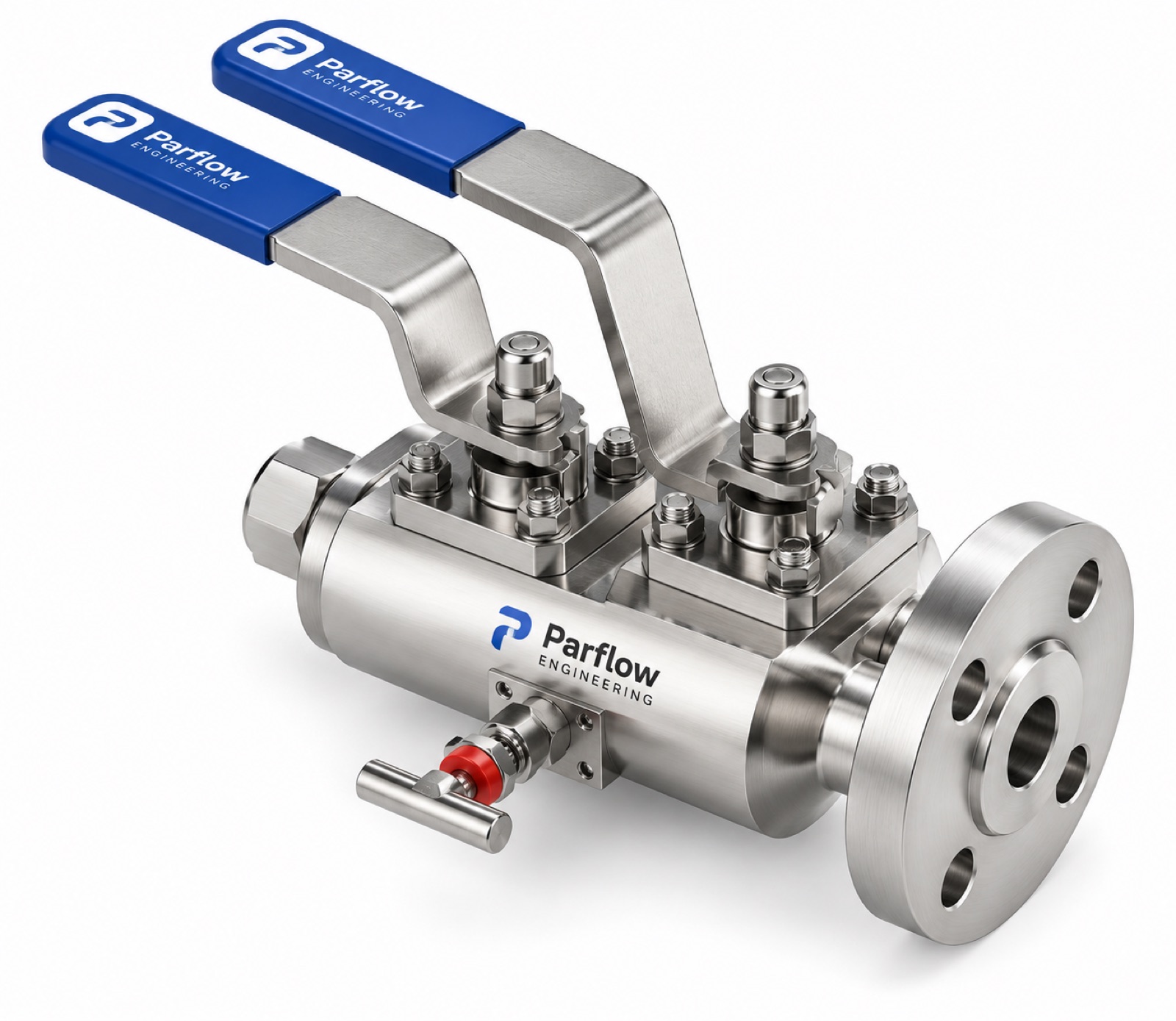
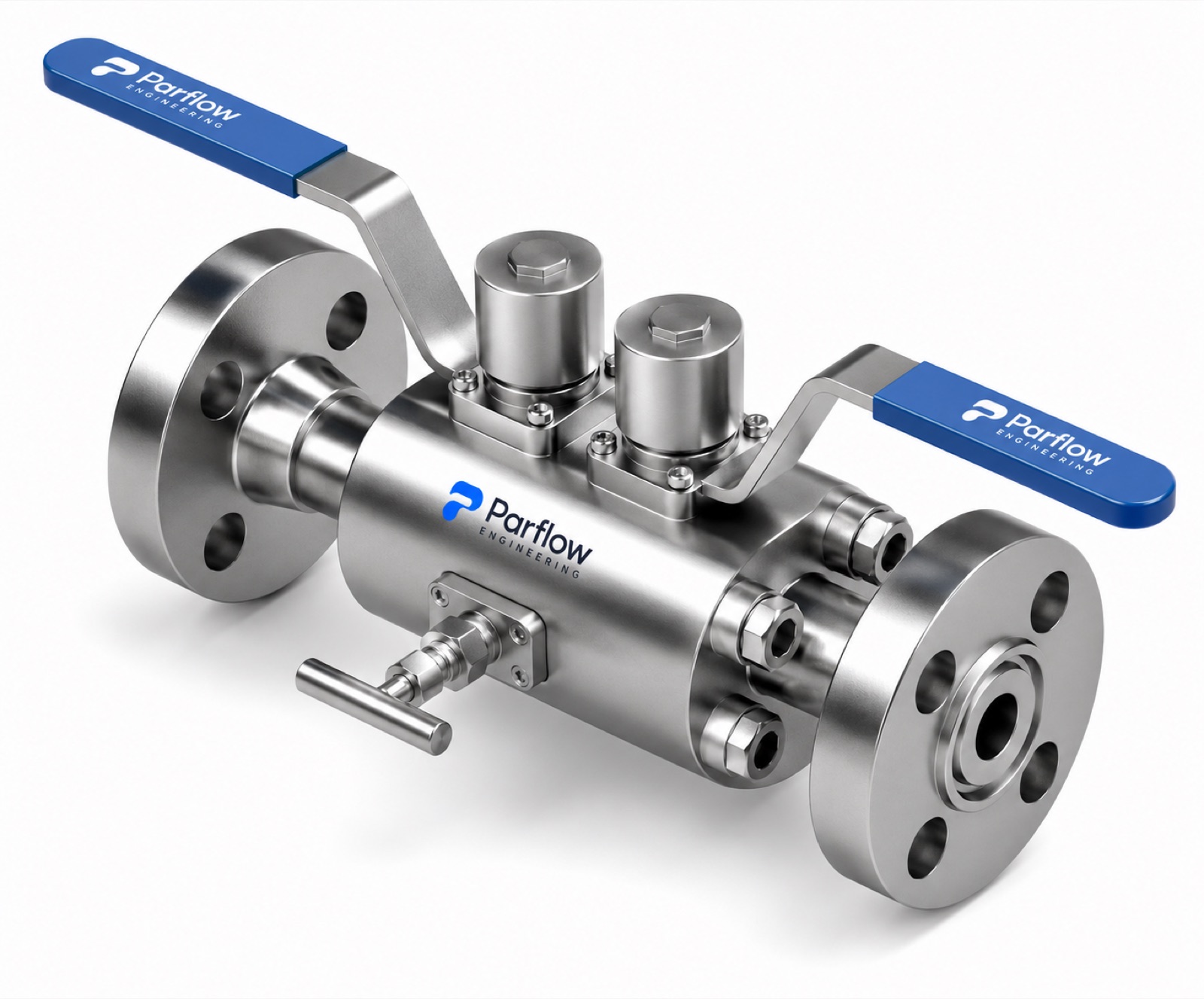
Parflow Double Block & Bleed (DBB) Valves are engineered to provide safe, efficient, and reliable process isolation in critical instrumentation and process systems. By integrating two independent isolation valves and a dedicated bleed valve into a single compact assembly, they enable positive isolation of process media while allowing the trapped cavity between the isolation points to be safely vented or drained.
This configuration significantly improves operational safety, reduces potential leak paths, and simplifies maintenance procedures compared to conventional multi-valve installations. In industries where process media may be hazardous, corrosive, flammable, or operating under high pressure, achieving reliable isolation is essential before maintenance, calibration, or equipment replacement can be performed.
Traditional installations typically require multiple individual valves connected through several fittings and piping components. While functional, these assemblies increase installation complexity, occupy valuable space, and introduce numerous potential leak points. Parflow Double Block & Bleed Valves offer a more efficient solution by consolidating these functions into a single precision-engineered unit.
The result is a cleaner installation, improved system integrity, reduced weight, faster commissioning, and greater confidence during plant operation and maintenance.
Working principle
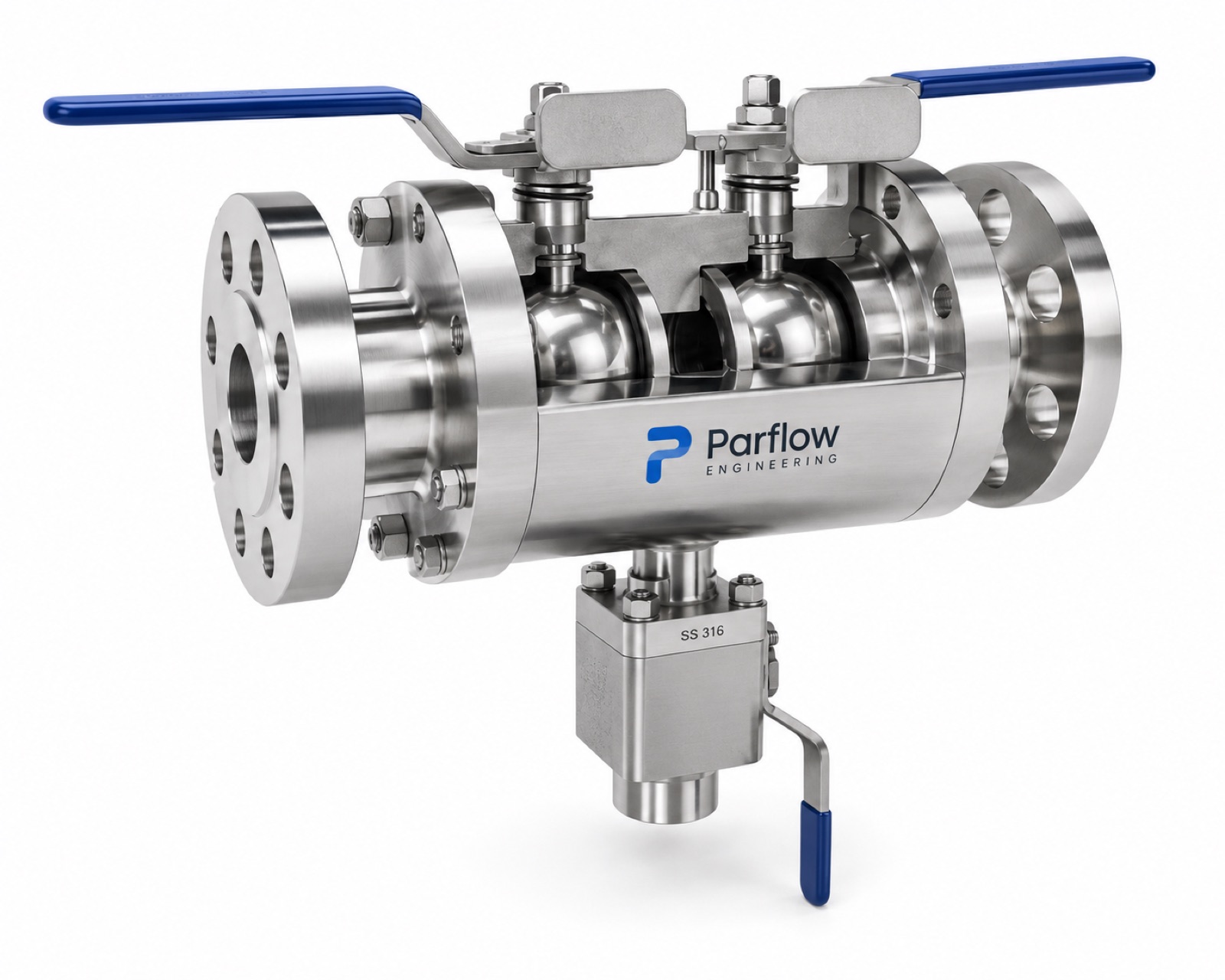
In operation both isolation valves are open. For maintenance, both are closed, two independent barriers between process and equipment, then the bleed valve vents the trapped cavity. If pressure keeps appearing at the bleed port, an isolation valve is passing: the DBB gives positive verification before anyone works downstream.
One machined body carries all three functions, replacing valves, nipples, and connectors: fewer threaded joints, lower fugitive emissions, less weight and bending load on piping, and better rigidity under vibration.
At a glance
The 10,000 psi ceiling puts the DBB in the upper tier of this family, and the 1/2" to 2" range covers larger line sizes than any sibling here.
Isolation sequence: what the three valves do in order
| Step | Action | State it establishes |
|---|---|---|
| 1 | Close block valve 1 | Upstream process isolated |
| 2 | Close block valve 2 | Second independent barrier closed |
| 3 | Open the integrated bleed needle valve | Cavity between the two blocks vented |
| 4 | Read the bleed port | No pressure at the bleed confirms both blocks are holding |
Step 4 is what separates a DBB from two valves in series: the bleed port between the blocks gives a physical test that isolation actually holds before anyone breaks the joint. Pressure still present at the bleed means a block is passing, do not proceed. Temperature limits are set by the chosen seat (PTFE, PEEK, or metal), not by the body.
Key features
- Two independent isolation valves + dedicated bleed in one body
- Isolation verifiable at the bleed port before maintenance
- Significantly fewer connections than conventional assemblies
- Reduced potential leak paths and fugitive emissions
- Compact, weight-saving envelope
- Liquid, gas, steam, and process service
Technical advantages
The greatest advantage of a Double Block & Bleed Valve lies in its ability to combine improved safety with simplified system design. Replacing multiple individual valves, fittings, nipples, and connectors with a single integrated assembly reduces installation time while improving overall system integrity. Fewer mechanical joints translate directly into fewer potential leak paths, reducing maintenance requirements and improving environmental performance.
The ability to vent the cavity between the two isolation valves provides positive confirmation of isolation, allowing maintenance personnel to verify that the system has been safely depressurized before beginning work. This feature is particularly valuable in hazardous process environments where residual pressure presents a significant safety risk. The compact construction also reduces system weight and minimizes bending loads imposed on process piping and instrumentation, making DBB valves particularly advantageous for offshore platforms, process skids, analyzer panels, and space-constrained installations.
Applications
- Pressure transmitter installations
- Pipeline isolation
- Wellhead instrumentation
- Chemical injection systems
- Custody transfer systems
- Sampling systems & analyzers
- Instrument impulse lines
- Process skids & OEM packages
Configurations
- Threaded
- tube fitting
- or flanged end connections; body patterns for direct instrument mounting or inline installation; compact monoblock and modular constructions per layout
- pressure
- maintenance requirements
Industries served
- Oil & Gas
- Petrochemical
- Refining
- Chemical Processing
- LNG & Industrial Gas
- Offshore Production
- Power Generation
- Hydrogen Energy
- Marine & Offshore
- Mining & Metals
Why choose Parflow
Effective process isolation is fundamental to plant safety, maintenance efficiency, and operational reliability. In critical applications, reducing potential leak paths while providing positive verification of isolation is not simply an operational benefit, it is an engineering necessity. Parflow Double Block & Bleed Valves are engineered to meet these demands by integrating multiple valve functions into one compact, precision-manufactured assembly.
They simplify installation, improve safety during maintenance, reduce emissions, and enhance the long-term integrity of instrumentation and process systems. Whether installed on pressure transmitters, process pipelines, sampling systems, or high-pressure instrumentation, Parflow Double Block & Bleed Valves provide engineers and plant operators with a dependable isolation solution that combines compact design, operational efficiency, and the confidence required for today's most demanding industrial applications.
FAQ
What is a double block & bleed valve?
A single assembly with two independent isolation valves separated by a vented cavity and a bleed valve. Closing both blocks and venting the cavity gives positively verified isolation of the downstream system.
Why is DBB safer than a single isolation valve?
Two barriers instead of one, and the bleed port proves they're holding. If pressure reappears at the bleed after venting, an isolation valve is leaking and maintenance can stop before exposure.
What does the integrated body improve?
Replacing a multi-valve hook-up removes most threaded joints: fewer leak paths, lower fugitive emissions, less weight and bending load, faster commissioning, particularly valuable offshore and on skids.