
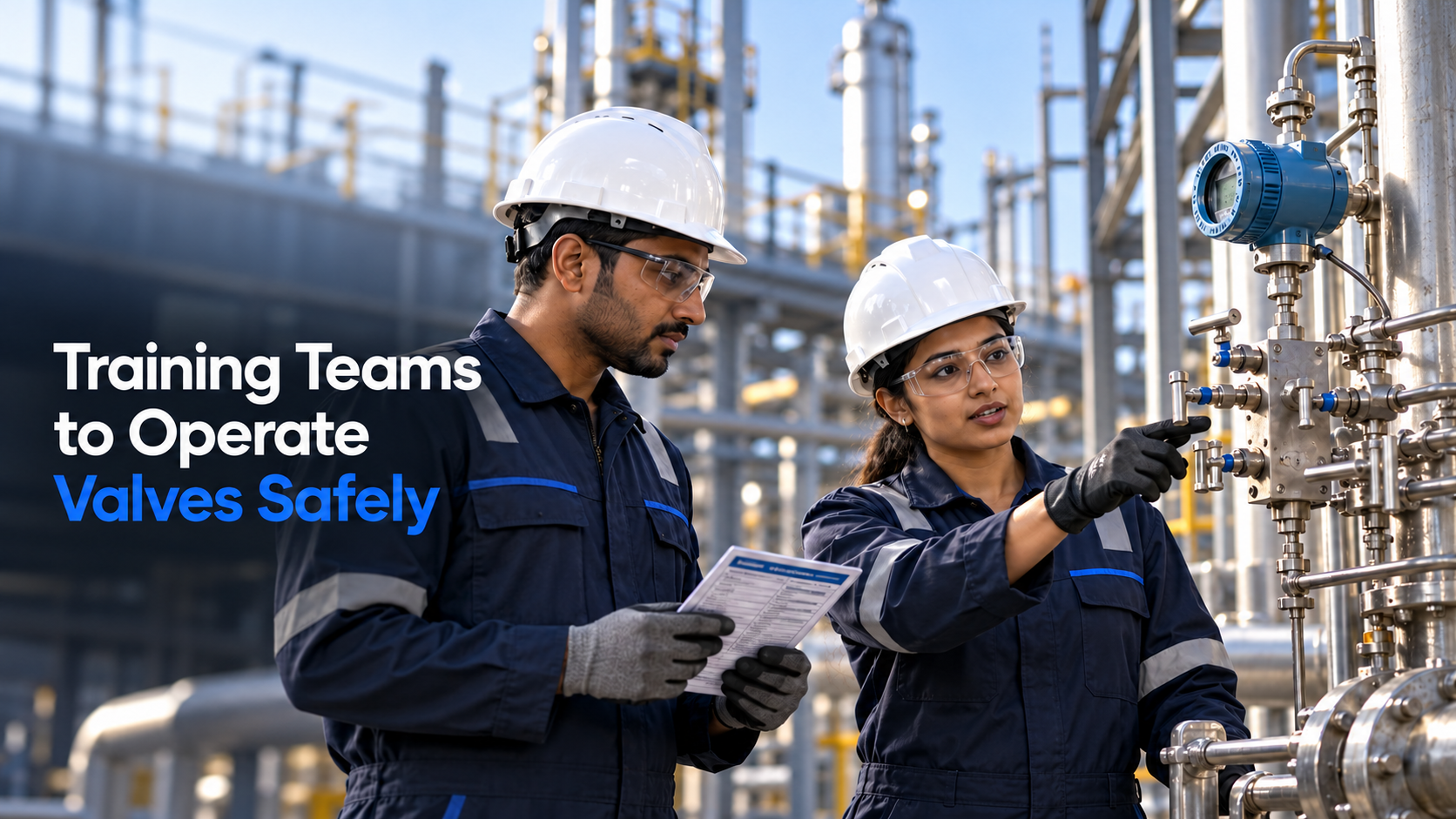
In a chemical plant, opening a valve is rarely an isolated action. It changes the path available to the process media and may affect pressure, flow, connected instruments, downstream equipment, or the route through which a chemical can escape.
An employee may know how to turn a handle and still misunderstand what the valve controls. That gap becomes especially serious around hazardous, corrosive, flammable, or high-temperature media.
Valve training should therefore begin with the process surrounding the component. Employees need to recognise the line, understand the media inside it, know what each valve does, and follow the correct operating sequence under both normal and abnormal conditions.
Begin With the Process Line
Before an employee operates a valve, they should be able to trace the process path around it.
This includes identifying what enters the valve, where the media can travel after it opens, which equipment is connected downstream, and what pressure or temperature may be present. The employee should also know where the media will go if a bleed or drain valve is opened.
Training should use the plant’s actual piping and instrumentation diagrams, hook-up drawings, valve tags, and operating procedures. A drawing becomes useful only when the employee can connect it to the physical installation.
During field training, ask the employee to identify:
a) The upstream and downstream sides
b) The valve’s normal operating position
c) Connected instruments and equipment
d) Isolation, vent, and drain points
e) The direction of flow
f) The expected pressure and temperature
g) The approved discharge or collection point
h) Nearby valves that form part of the same sequence
Tags and colour coding make identification easier, but employees should still verify the valve against the current procedure before operating it.
Explain What Each Valve Is Designed to Do
Different valves may look similar from a distance while performing completely different functions.
- Needle valve: Provides gradual flow adjustment or controlled isolation.
- Ball valve: Generally provides rapid quarter-turn shutoff.
- Manifold: Combines several functions, such as isolation, equalisation, venting, and calibration, within one assembly.
- Bleeder plug: Releases trapped pressure through a small vent passage.
- Double block-and-bleed arrangement: Provides two isolation barriers with a bleed point between them.
Employees do not need to study every detail of valve design, but they should understand how the internal construction relates to operation.
For example, an isolation ball valve should not automatically be used for throttling. A needle valve should not be forced against its seat to obtain a tighter shutoff. Manifold valves must be operated in the correct order to avoid exposing an instrument to an unintended pressure difference.
Cutaway samples are particularly useful here. They allow the employee to see what moves inside the valve when the handle or stem is operated. This makes the limitations of the component easier to understand than an external photograph alone.
Teach the Entire Operating Sequence
Many valve-handling problems begin when the correct valves are operated in the wrong order.
This is especially relevant to instrument manifolds, pressure-gauge installations, sampling systems, and assemblies that contain isolation, equalising, vent, and drain valves.
A procedure should identify the actual valves and state what must be checked after each action. It should cover normal startup and shutdown, instrument isolation, depressurisation, maintenance, calibration, recommissioning, and emergency conditions where relevant.
A typical instrument-isolation procedure may require the employee to confirm the line, communicate with the control room, close the process isolation valve, release trapped pressure, verify that pressure is not rebuilding, and secure the appropriate isolation points before maintenance begins.
The exact sequence depends on the installation. Employees should not rely on a sequence remembered from another manifold or process unit.
Training should also explain why the order matters. Opening an equalising valve at the wrong time can affect a differential-pressure measurement. Leaving a vent open during recommissioning can release process media. Closing a valve too quickly may create a pressure surge in some systems.
When employees understand the consequence behind each step, they are less likely to treat the procedure as a list to be memorised and forgotten.
Make Stored Pressure Part of the Training
Closing a valve does not remove the liquid or gas already trapped downstream.
Pressure can remain inside instrument cavities, impulse lines, manifolds, hoses, actuators, and sections of piping between closed valves. It may also rebuild if the isolation valve passes or if trapped liquid expands as its temperature changes.
Employees should know how the system is depressurised and how that condition is verified. This includes identifying the correct vent or drain, opening it slowly, controlling the discharge, and observing whether the flow stops.
If discharge continues, the employee should recognise it as a possible isolation problem. The correct response is to stop the task and investigate rather than continue opening the equipment.
Hydraulic, pneumatic, spring, electrical, thermal, and gravitational energy may also affect valve-related maintenance. Training should cover every energy source relevant to the task instead of treating process pressure as the only concern.
Connect Valve Operation With Chemical Exposure
The procedure for operating a valve should reflect the media inside the line.
An employee working with steam faces different hazards from someone handling a corrosive liquid, flammable gas, high-purity chemical, or substance that reacts with air or moisture.
Before operating a vent, bleed, drain, or sampling valve, the employee should know:
Whether the media can be released locally
What containment or drainage is required
Which personal protective equipment applies
Whether monitoring or ventilation is needed
What to do if exposure occurs
Which conditions require evacuation or emergency shutdown
Some media can be discharged into a suitable container. Others require a closed drain, recovery line, treatment system, or controlled vent route. The valve may function correctly while the discharge arrangement remains unsafe.
This part of the training should be specific to the chemical and the process area. A general instruction to “open slowly” does not replace a proper plan for handling the released media.
Teach Employees When to Stop
A good operator does not force the equipment to match the procedure when the physical conditions suggest something is wrong.
Employees should stop and escalate the task if they encounter:
- Unexpected resistance while operating a valve
- A handle position that does not match the indicated status
- Continued discharge after isolation
- Pressure that does not fall or begins to rebuild
- Leakage from the stem, body, or connections
- Unusual vibration, noise, or temperature
- A damaged, corroded, or unreadable valve
- Missing identification
- A difference between the drawing and installation
Using a longer lever on a valve that will not move can damage the stem, seat, handle, actuator, or adjoining tubing. Repeatedly tightening a leaking valve may also worsen internal damage without correcting the original cause.
Training should give employees a clear escalation route. They need to know whom to contact, how to leave the equipment in a controlled state, and what information to report.
Practise on Equipment, Not Only in a Classroom
A presentation can introduce valve types and procedures. It cannot show whether an employee can identify the correct valve under plant conditions.
Practical training should use de-energised assemblies, training rigs, cutaway components, or controlled field demonstrations. Employees should practise tracing the process path, identifying the valves, checking the required positions, following the operating sequence, and responding to unexpected conditions.
The exercise should resemble the real task. If employees normally work while wearing gloves and eye protection, the training should account for that. If the valve is installed above shoulder height or in a confined position, accessibility should be discussed rather than ignored.
Trainers can introduce controlled complications, such as an unclear tag, a vent that continues to discharge, or a procedure that does not match the training assembly. These exercises show whether the employee can recognise a problem instead of continuing mechanically through the steps.
They can also expose weaknesses in the installation itself. Poor access, confusing tags, similar handles, or inadequate vent routing cannot always be corrected through training. Some problems require an engineering or procedural change.
Assess the Employee’s Actual Competence
Attendance does not demonstrate the ability to operate a valve safely.
An employee should be able to explain the process hazards, identify the correct valve, describe what it controls, follow the required sequence, and respond appropriately when the system behaves differently from expected.
A practical assessment can ask the employee to:
- Identify the line and process media.
- Trace the relevant flow path.
- Explain the function of each valve in the assembly.
- Describe the required operating sequence.
- Demonstrate the procedure on safe equipment.
- Identify the conditions that would make them stop.
- Explain how isolation and depressurisation are verified.
The assessment should be documented along with the process area and equipment covered. An employee trained on a simple gauge valve should not automatically be considered competent to operate a five-valve manifold or a double block-and-bleed assembly.
Keep the Training Current
Training material should change when the plant changes.
A new process chemical, revised operating pressure, replacement valve design, altered manifold arrangement, relocated drain, or updated operating procedure may affect how the component must be handled.
Training should also be reviewed after valve-related incidents, near misses, repeated deviations, turnarounds, equipment modifications, or long periods during which an employee has not performed the task.
Operators and maintenance technicians should be included in these reviews. They often notice damaged tags, inaccessible valves, confusing layouts, and differences between the procedure and the actual installation before those issues appear in a formal audit.
Building a Practical Valve-Training Programme
A useful valve-training programme for a chemical plant can be organised around five stages:
- Process knowledge: Media, hazards, flow path, pressure, temperature, and operating limits.
- Component knowledge: Valve type, function, construction, position, and limitations.
- Procedure: The correct sequence for normal operation, isolation, maintenance, and abnormal conditions.
- Practical training: Supervised operation on a safe assembly or controlled installation.
- Competency verification: Demonstration, assessment, documentation, and refresher planning.
This approach prepares employees to understand the effect of an action before they operate the valve.
Conclusion
Safe valve handling in a chemical plant depends on more than familiarity with the component. Employees need to understand the process, the chemical hazards, the operating sequence, and the signs that conditions are no longer normal.
Training should reflect the actual equipment installed at the plant and include supervised practice. Employees should demonstrate competence before working independently, while procedures and training material should remain aligned with changes to the process.
Correctly selected valves support reliable operation, but their performance throughout service also depends on informed operation and maintenance.