
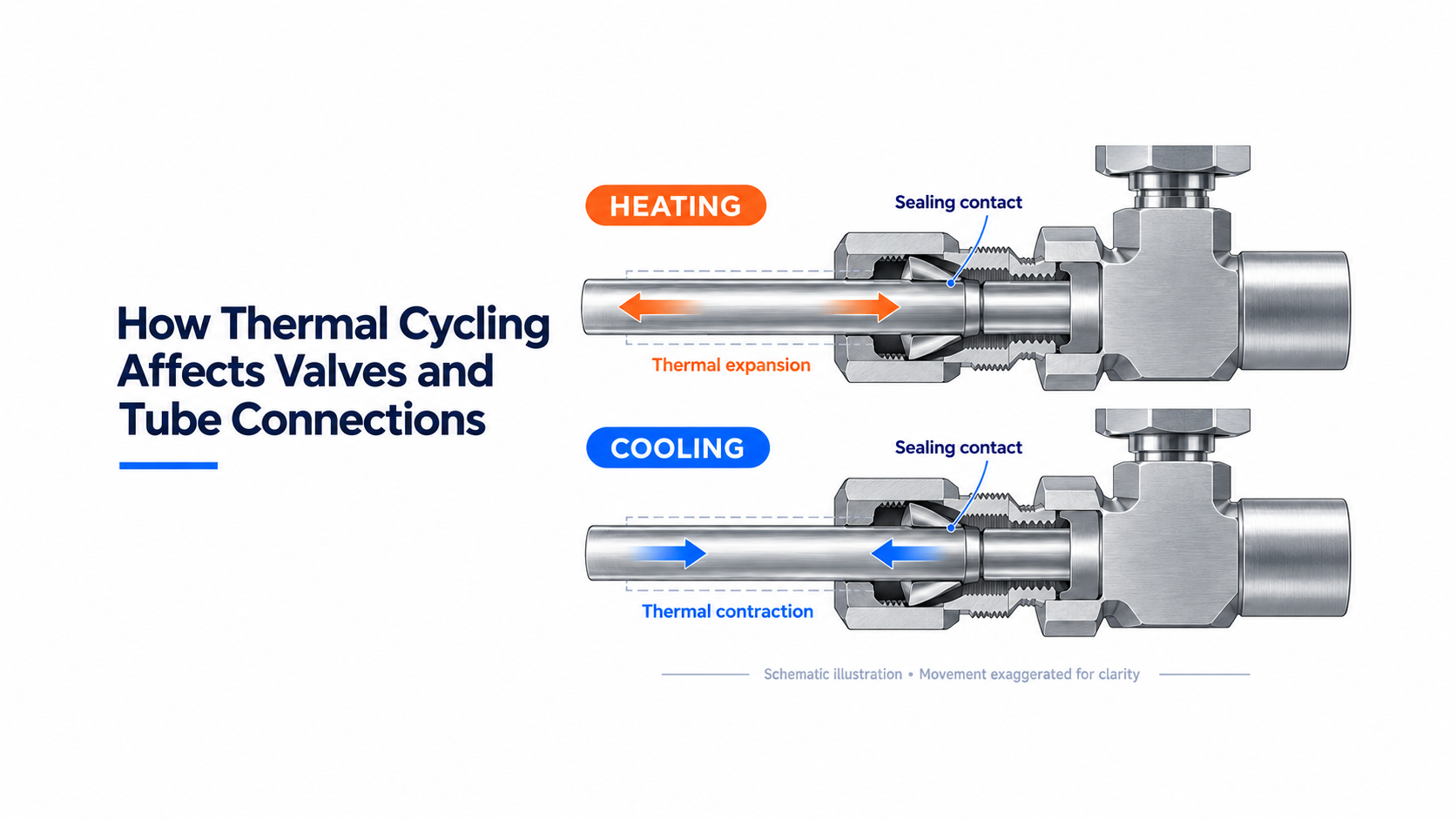
A connection passes its leak test during installation, operates normally for several weeks, and then begins leaking during startup. By the time maintenance inspects it at a stable temperature, the leak has disappeared.
Intermittent problems like this can be difficult to trace. Installation quality, vibration and process conditions all deserve attention, but the temperature history of the assembly is often just as important.
Valves and tubing expand as they heat and contract as they cool. When this happens repeatedly, the resulting movement can affect sealing contact, load the connections and contribute to wear or fatigue. Understanding these effects helps engineers investigate recurring leaks and specify components for the conditions they will actually experience.
Thermal Cycling Extends Beyond the Maximum Temperature
Thermal cycling is repeated heating and cooling during service. It occurs during batch processing, equipment startup and shutdown, hot cleaning cycles, steam tracing, and transitions between ambient and refrigerated operation.
The highest temperature is only one part of the assessment. The temperature range, speed of change, time spent at each extreme and number of cycles also matter. A connection held steadily at an elevated temperature experiences different demands from one repeatedly heated and cooled through the same range.
Rapid changes can be particularly demanding because the parts of an assembly do not necessarily heat or cool together. Thin-walled tubing may respond faster than a heavier fitting body, temporarily creating a temperature difference even when both are made from the same alloy. Differences in material expansion add another variable.
What Changes Inside a Valve
A valve contains several parts that must maintain their relationship as temperature changes: the body, stem, seats, packing and other seals. Their materials and dimensions influence how the assembly responds.
In soft-seated valves, temperature affects the behaviour of the seat material as well as the metal surrounding it. Expansion, deformation under load and changes in resilience can influence sealing performance. Elastomeric seals may also develop compression set over time, reducing their ability to recover as conditions change. These effects depend on the material, temperature exposure and chemical service; they are not inevitable in every cycling application.
This is why selecting a stainless-steel body does not establish the temperature capability of the complete valve. The seats or stem seals may impose a lower limit. Pressure and temperature ratings must be checked together for the actual configuration, rather than treating the maximum values as independently available.
Metal-seated designs also require application review. Removing a polymer seat does not remove thermal movement, temperature gradients or loads transferred from connected tubing.
How Tube Connections Are Affected
A compression fitting depends on controlled contact between the tube, ferrules and fitting body. Temperature changes can alter the loading at these interfaces, particularly when the components differ in material or respond to heat at different rates.
Correctly selected and assembled fittings can accommodate demanding temperature cycles. Cycling does not automatically mean that a fitting nut will loosen. However, a marginal installation may become apparent only after the assembly has experienced repeated temperature changes.
Tube condition, insertion depth, wall thickness and assembly method remain important. A damaged sealing surface or incorrectly assembled connection may pass an initial check without providing dependable performance throughout service.
For demanding applications, relevant thermal-cycle test data can help evaluate a fitting system. The evidence should identify the tubing and fitting combination, test temperatures, pressure, cycle count and leakage criteria. Results for one tested configuration should not be assumed to apply to every size, material or installation.
Tubing Layout Can Transfer Movement Into the Valve
The connection itself is only part of the problem. A tube run needs space to expand and contract.
When tubing is rigidly restrained between fixed points, thermal movement can generate loads at fittings, valve bodies and instrument connections. Repeated loading may contribute to fatigue, particularly where it combines with vibration or an existing stress concentration. Inadequate consideration of movement can also damage supports or distort connected components.
Consider a tube connected between a heated process line and a separately mounted instrument. The two ends may move differently as the process warms. If the route has little flexibility, the connection must absorb the resulting load.
Routing and supports should therefore be designed together. Appropriate bends or offsets can provide flexibility, while supports control unwanted movement. Adding more clamps without reviewing their position may restrict the expansion the installation needs to accommodate. Suitable geometry depends on the tube dimensions, available space and expected movement.
Investigating a Leak That Appears During Startup
When a leak follows a temperature change, record when it occurs before deciding what to replace.
Useful observations include:
- Whether leakage begins during heating, cooling or steady operation
- The pressure and temperature at the time
- How quickly the temperature changes
- Recent changes to cleaning, startup or shutdown procedures
- Movement at supports and connected equipment
- Whether the same location has required repeated maintenance
These details help distinguish a local sealing problem from a wider installation issue. A leak that returns at the same joint after replacement warrants a review of alignment, restraint and operating conditions, not just another replacement fitting.
Inspection during temperature transitions must use approved methods appropriate to the process hazards. Do not loosen or tighten a pressurised connection to investigate it. Isolate, depressurise and establish a safe temperature before intrusive work.
Specify the Full Operating Cycle
An enquiry stating “maximum temperature: 150°C” leaves several important questions unanswered. Does the assembly reach that temperature once a month or several times a shift? Is the change gradual? Is the line pressurised while it heats? Does cleaning expose the seals to a different chemical?
For cyclic service, provide the supplier with:
- Minimum, normal and maximum temperatures
- Heating and cooling rates, where known
- Cycle frequency and expected service life
- Pressure conditions throughout the cycle
- Process and cleaning media
- Valve seat, packing and seal requirements
- Tube material, outside diameter and wall thickness
- Vibration, support and installation constraints
This gives the selection review a more useful basis than a single pressure or temperature rating.
It also helps define inspection and testing requirements. An ambient leak test confirms performance under that test condition; it does not, by itself, demonstrate long-term performance through repeated heating and cooling.
Review the Assembly Before Replacing the Component
Recurring leakage can be expensive even when the replacement part is inexpensive. Each intervention may involve isolation, draining, access, testing and a delayed return to service.
The investigation should establish whether the problem comes from the component, its installation or the duty it is being asked to perform. Replacing a valve with the same configuration may leave an unsuitable seal material unchanged. Replacing a fitting may leave excessive tubing restraint unresolved.
For applications with frequent temperature changes, share the full operating cycle when discussing instrumentation components with Parflow. Details of the media, pressure, temperature transitions and tubing arrangement help establish which valve, manifold or fitting configuration should be considered. You can explore the range at parflowengineering.com and include these conditions with your enquiry.